


What we did
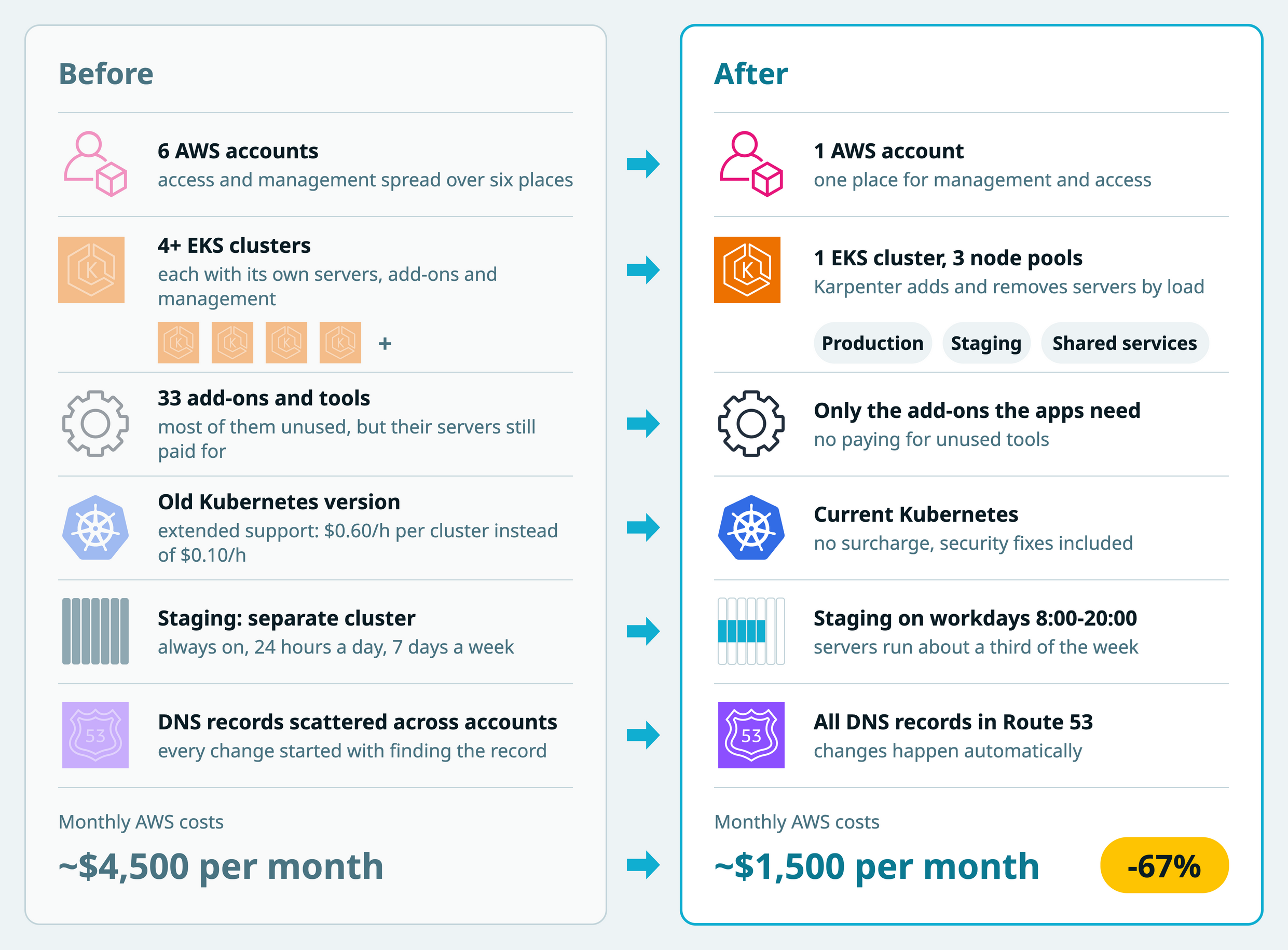
- We merged what was needlessly split. We combined 6 AWS accounts and 4+ clusters into one account and one cluster. Servers and tools AgeVolt didn't need are gone.
- We upgraded Kubernetes. AWS charges a surcharge for old versions, and AgeVolt no longer pays it.
- They pay only for what runs. The test environment runs only during working hours, and servers are added and removed based on load.
How the project went
The project took about five months, from October 2024 to March 2025. We moved the applications and data to the new infrastructure ourselves, with no downtime, and the charging stations kept working the whole time. Since then, we have been running AgeVolt's infrastructure as part of our support.
About the customer
AgeVolt Slovakia s. r. o. is an e-mobility startup based in Bratislava. It runs a growing network of EV charging stations across Europe. The stations talk to AgeVolt's platform over the Internet of Things (IoT), so the infrastructure has to handle messages from the stations reliably and in real time.
Project type: AWS infrastructure consolidation and cost optimization
Services: AWS account consolidation, Amazon EKS, GitOps (ArgoCD), CI/CD (GitHub Actions), monitoring (Prometheus, Grafana, Loki)
The challenge
AgeVolt's infrastructure had been built by a previous provider on its own reference architecture. That architecture is designed for large enterprises with dozens of teams, not for a startup with one product. The result:
- 6 AWS accounts holding 4+ EKS clusters. Each cluster had its own servers, its own add-ons and its own upkeep.
- 33 add-ons and tools across the clusters, for network policies, a service mesh, distributed tracing and long-term metrics storage, among others. AgeVolt didn't need most of them, but paid for the servers they ran on.
- An old Kubernetes version. Once a version leaves standard support, AWS charges an extended support surcharge for every cluster: $0.60 an hour instead of $0.10, six times as much.
- DNS records scattered across several accounts, so every change started with finding out where the record actually lived.
- Outdated, inconsistent Terraform code that was hard to maintain.
Monthly AWS costs had reached around $4,500 and were still climbing.
Our solution
The Axyra team first mapped what AgeVolt actually needs to run its product. It then built new infrastructure containing only that, and moved all applications and data into it.
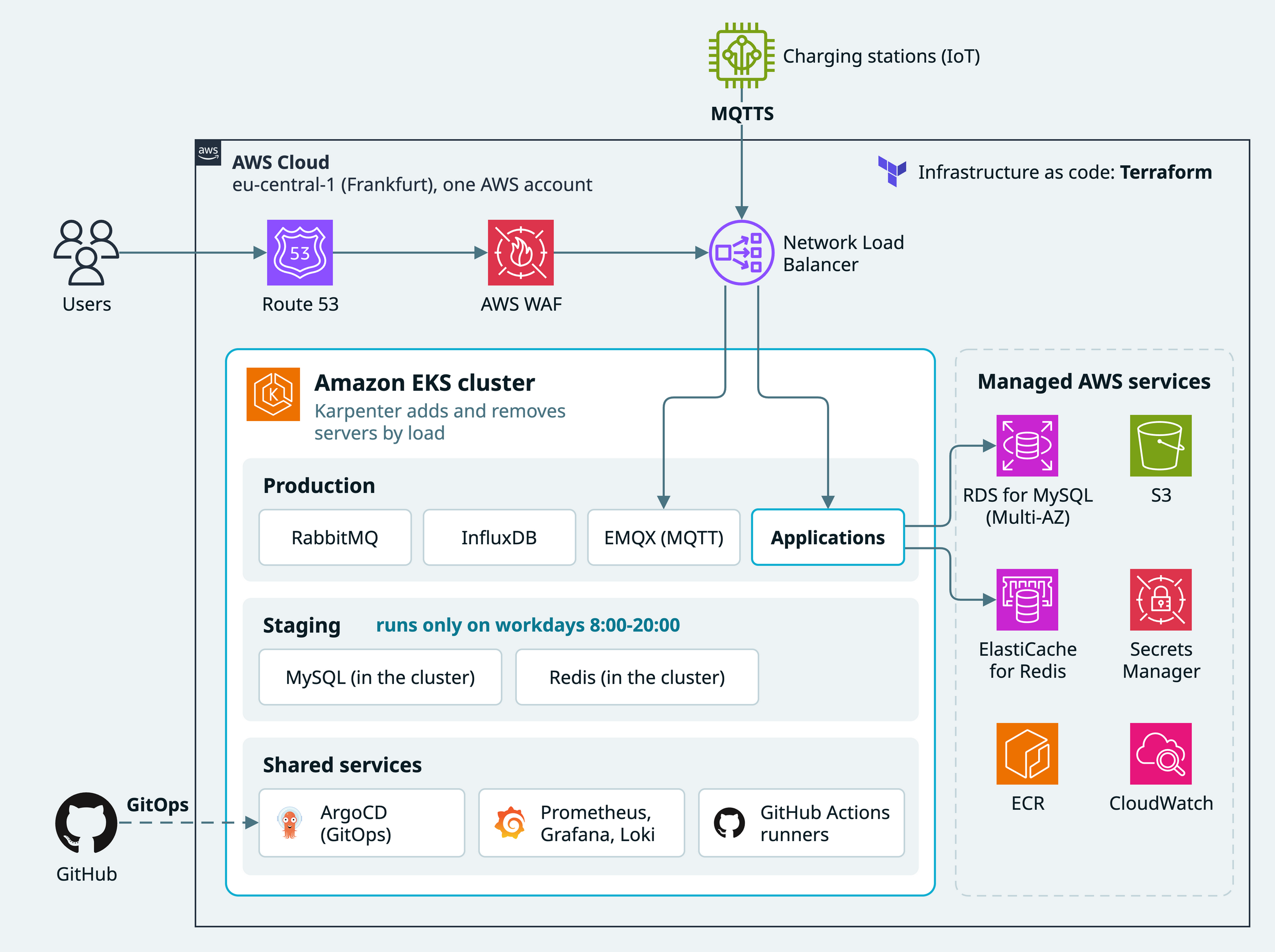
One account, one cluster. Everything runs in one AWS account and one Amazon EKS cluster. Production, staging and shared services each have their own node pools inside the cluster, so they stay separated without needing separate clusters.
Current Kubernetes. We upgraded Kubernetes, so AgeVolt pays no extended support surcharge and receives security fixes. We keep it up to date as part of our support.
You only pay for what runs.
- Karpenter adds and removes servers based on how much capacity the applications need at any moment.
- Staging runs only on workdays from 8:00 to 20:00, about a third of the week. Outside those hours it shuts itself down, and developers can start it with a single command when they need it.
- Only production uses managed high-availability databases. Staging runs MySQL and Redis inside the cluster.
Managed AWS services. The production database runs on Amazon RDS for MySQL across multiple Availability Zones with automated backups, and caching runs on Amazon ElastiCache for Redis. All DNS records live in Amazon Route 53 and update automatically. Passwords and keys are kept in one place, in AWS Secrets Manager.
Talking to the charging stations. Stations connect over encrypted MQTTS to an EMQX broker in the cluster. RabbitMQ carries internal messages between services.
Automation. The entire infrastructure is defined in Terraform. Applications are deployed with ArgoCD straight from Git (GitOps). Tests and builds run on GitHub Actions runners in the same cluster, which start only when there is work to do.
Monitoring. Prometheus, Grafana and Loki show the state of the cluster, the applications and the logs in one place.
Results
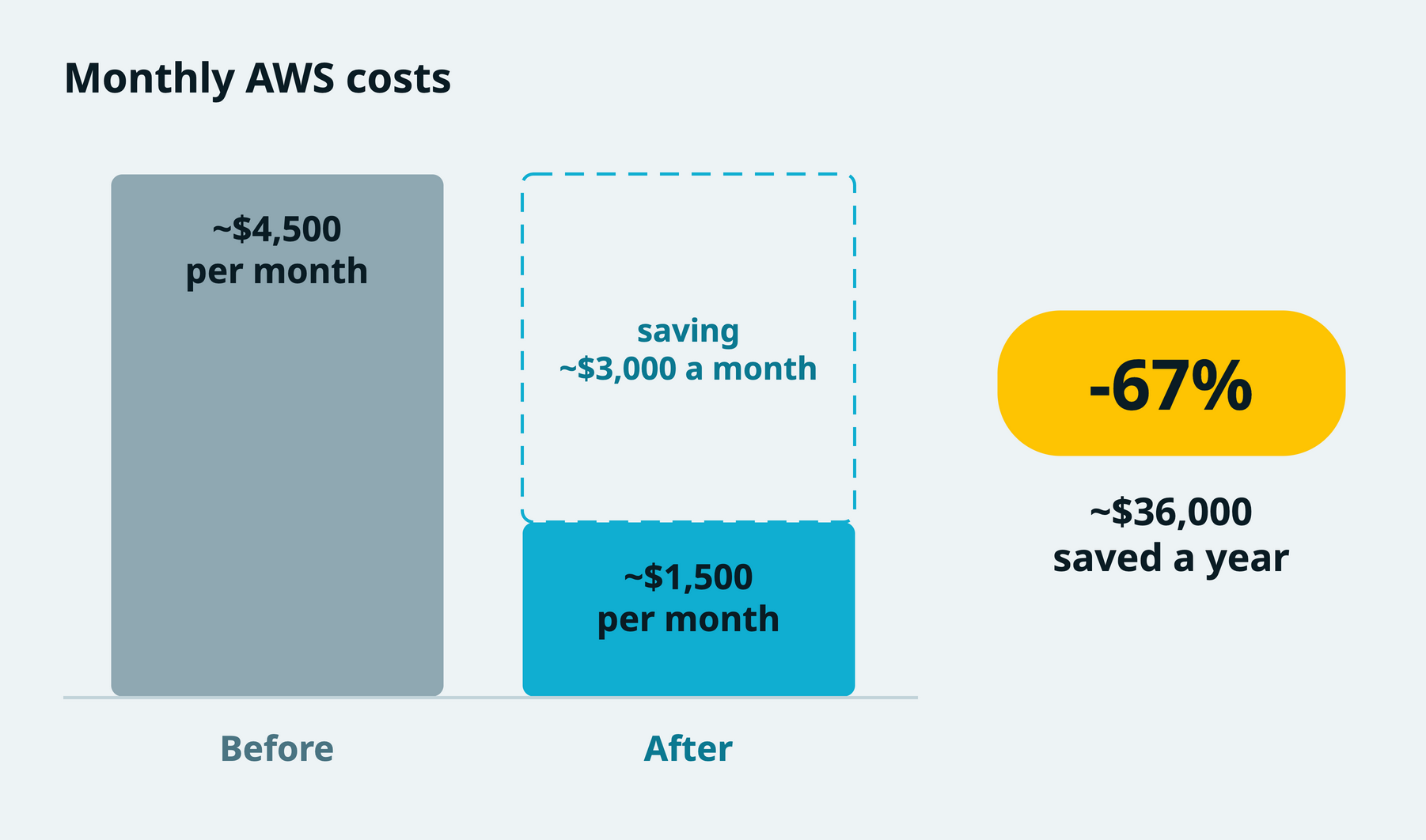
Monthly AWS costs fell from $4,500 to $1,500, a 67% reduction. That saves around $36,000 a year. The infrastructure is also easier to run: instead of six accounts and four clusters, AgeVolt has one account and one cluster that grows with its charging network.
| Before | After | What it brought | |
|---|---|---|---|
| Monthly costs | ~$4,500 | ~$1,500 | 67% less |
| Annual costs | ~$54,000 | ~$18,000 | ~$36,000 saved a year |
| AWS accounts | 6 | 1 | one place for management and access |
| EKS clusters | 4+ | 1 | fewer servers, less upkeep |
| Cluster add-ons | 33 | only what the apps need | no paying for unused tools |
| Kubernetes | old version with an AWS surcharge | upgraded | no surcharge, security fixes included |
| Staging | separate cluster | runs only on workdays 8:00 to 20:00 | servers run about a third of the week |
| DNS records | scattered across accounts | one place in Route 53 | changes happen automatically |
| Terraform code | outdated and inconsistent | consistent | easier upkeep and development |
